What the Bible says wants to be discovered. Here is a worksheet to support your adventure.
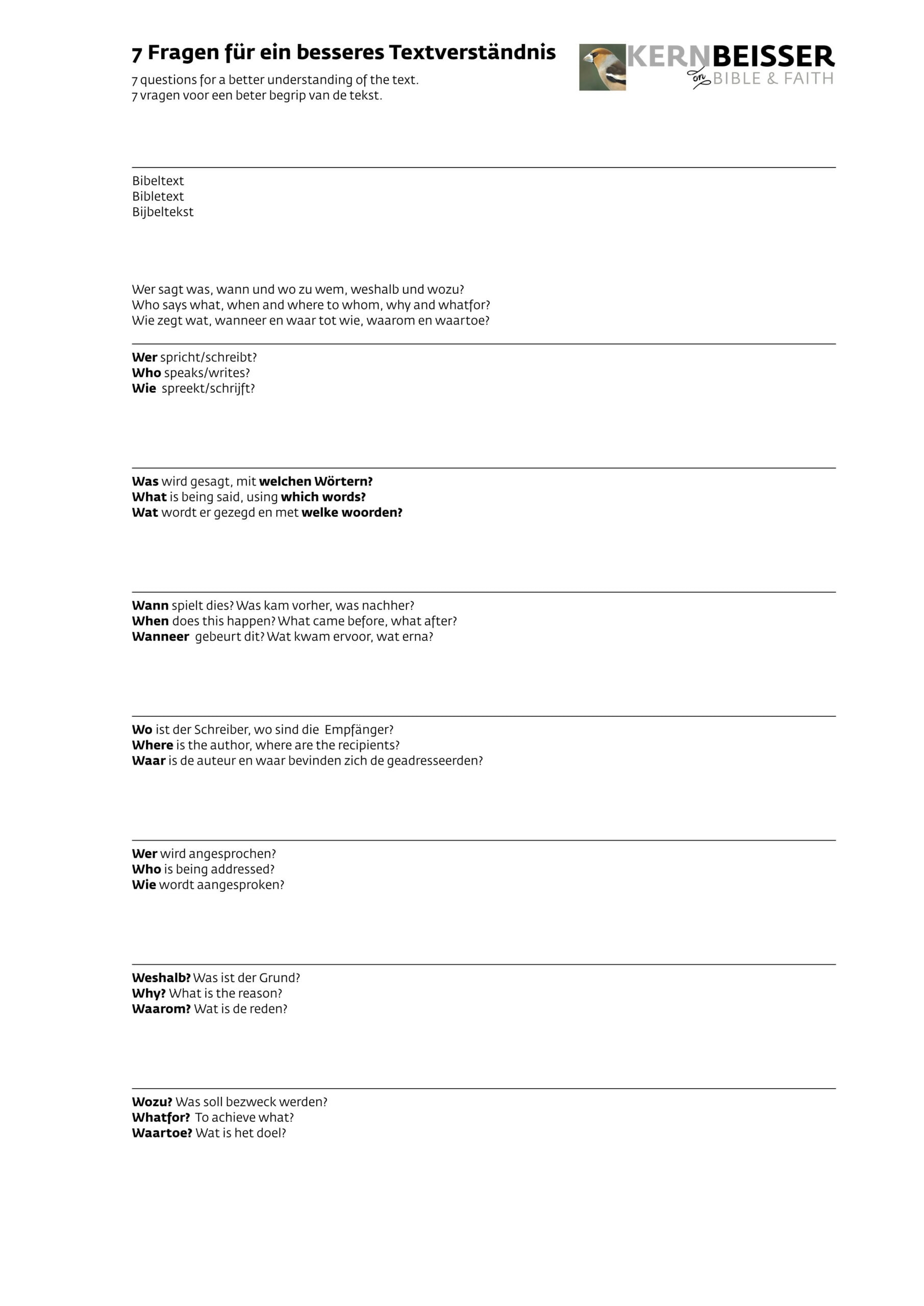
This Bible study worksheet aims to be a help toward better understanding of the text. It’s a series of questions that help track down the text and its statement.
Worksheet
The worksheet is a PDF file that can be easily printed out. This way, in a Bible study or house group, everyone can work with their own sheet. Which Bible text is used is up to you. The worksheet is thus generic and not an interpretation. It does, however, ask about the text, and one gathers information that helps in learning to understand the text better.
Seven Questions
Seven questions about the text help track down the details. These questions are also known as the “7 W-questions.” They can be summed up in a single sentence:
Who says what, when and where, to whom, why and to what end?
Not every text will engage all these questions equally. That’s fine. Yet, the significance of these questions is great. Theologically differing viewpoints often result from disregarding these questions. But whoever can answer the questions have gained a wonderful insight into the text.
What Is Written, and What Isn't?
With the help of these questions, one gains additional insights. It becomes easier to distinguish between real textual grounding and historical interpretation. Texts are often cited to prove something that isn’t stated in the text at all. This often only becomes apparent, though, once one carefully compares the teaching with the cited Bible text.
Imagine wanting to examine a text because you want to understand a teaching better. The teaching makes a statement and then cites a text for it. Do the words of the teaching actually appear in the cited text? No? Then perhaps one needs to dig deeper and ask why something can’t be found in the text.
Recognizing One's Own Assumptions
When I began reading Bible texts more carefully, it was uncomfortable at first. I often found my original assumptions unconfirmed. I had to learn to bear that tension. Then came the questions about what was actually written.
One’s own assumptions, or the assumptions of the community one belongs to, often unconsciously shape how one reads the Bible. Only when one sets out on one’s own and asks concrete questions can one gain a better insight. That is what these seven questions are meant for.